



The Challenge
Dated design was the surface problem. Underneath it were harder ones.
The Western Travel Agencies Association, known as Westa, is a member-owned travel consortium competing for independent travel agents. Their website was their primary sales tool, and it was working against them.
Josh Burke, Westa’s Senior Director of Sales and Marketing, remembers his own first impression, from before he was hired: “When I was researching the company online before joining, I thought, ‘Is this still completely operational?’ The graphics looked dated, and for catching younger members, we weren’t making a good first impression.”
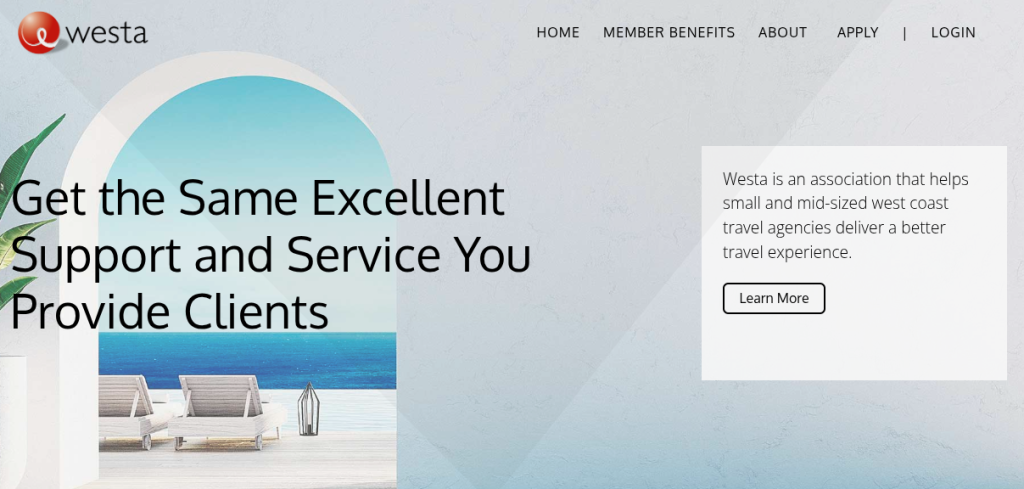
Dated design was the surface problem. Underneath it were harder ones. Westa’s structure is genuinely unusual, a cooperative owned by its members rather than a host agency, and prospects could not tell from the site what that meant or why it should matter to them. The information they needed was scattered across too many thin pages, so understanding the full offer took a scavenger hunt that most people abandoned before reaching the inquiry form. The membership base skewed older, while growth depended on agents in their thirties and forties who were outgrowing host agencies. And the site framed joining as an application, which turns an exploratory question into a commitment.
There was also a stranger problem. The cooperative model, where profits return to members and participation is voluntary, sounded good enough to be suspicious. “What’s the catch?” was the question Josh fielded most often on inquiry calls.
So they came to us with three things to fix. Make the cooperative model immediately understandable. Make the site credible to a forty-year-old agent researching on their phone. And turn a formal application into an easy conversation.
What We Did
We did not start with design. We started with the argument.
We did not start with design. We started with the argument.
Before any visual work, we ran strategy sessions with Josh to map the psychology of the person Westa needed to reach: an agent five or six years into a host agency relationship, ready for more control over their own business. Working through our Member Benefits Bridge framework, we established where prospects sat on the path from pain aware, meaning frustrated by how much revenue the host agency kept, to solution aware, meaning they understood consortia as an option. We established what they were actually doing on the site, which was browsing with low intent rather than deciding. We wrote down the questions they needed answered: What size do I need to be? What’s the catch? Can I get out if it doesn’t work? And we named the risks they were weighing, including contract lock-in and whether a cooperative model was even legitimate.
Once we had established a strong messaging strategy and content to communicate the value of membership, we transitioned into the look and feel with design. A homepage hero built for credibility without losing the community feel that makes a cooperative worth joining. A single page, The Westa Difference, that explains the model in one place.
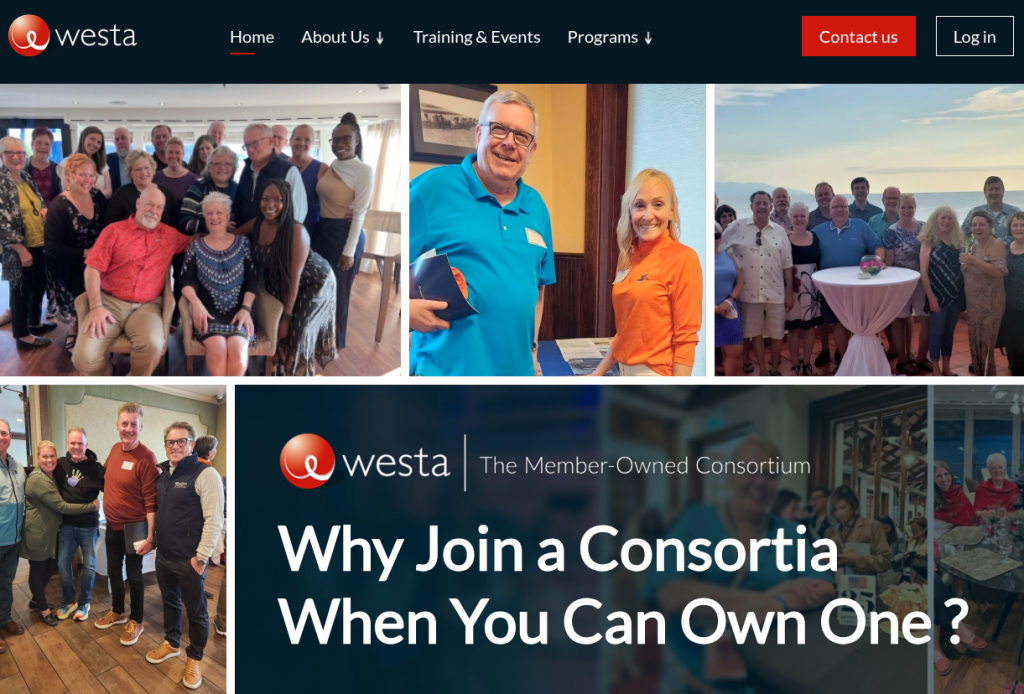
Photography did more of the work than usual. We used real photographs of Westa members together: talking with each other, taking part in the organization, learning in educational sessions. No stock imagery anywhere. A prospect can tell the difference immediately, and an organization built on community that cannot show its own community has already answered the question about whether it is worth joining. We also chose images that deliberately spanned generations, so an agent in their thirties and a thirty-year veteran could each see someone like themselves, rather than one of them recognizing it as a place they would not fit.
Custom graphics carried the rest of the argument. Instead of leaving the comparison between Westa, host agencies, and national consortia to prose alone, we illustrated it, so the case for membership was visually clear before anyone read a word of it.
We also shortened the path to a conversation. Calendly and form integrations for inquiries, an FAQ section structured to answer common questions directly in search results, a footer contact form for low-commitment contact, and calls to action that invite a conversation rather than an application.
The Result
Westa now has a modern design that clearly communicates the value of membership and provides a compelling view into what it’s like to belong in their community.
Westa now has a modern design that clearly communicates the value of membership and provides a compelling view into what it’s like to belong in their community.
The cooperative model is explained in one place instead of assembled across five. The distinction between Westa, host agencies, and national consortia is stated rather than implied. And the inquiry path asks for a conversation instead of a commitment, which removes the friction that was keeping qualified leads from making contact at all.
Live site: https://joinwesta.com
Metrics:
- 56% increase in engaged sessions
- 53% increase in time on site
56%
increase in engaged sessions
53%
increase in time on site
Live sites
Westa. Visit joinwesta.com
The Westa Difference. A single page that explains the model in one place.
“We worked with Steward to do a complete redesign of our public facing website. The old site looked outdated and was difficult for potential clients to navigate. Steward helped guide us through the redesign process and took on the entirety of the build out process as well. Both the designers and the engineers were patient, helpful, and knowledgeable. We are very happy with the new website and are already seeing an increase in new members and interest in our organization.”
We worked with Steward to do a complete redesign of our public facing website. The old site looked outdated and was difficult for potential clients to navigate. Steward helped guide us through the redesign process and took on the entirety of the build out process as well. Both the designers and the engineers were patient, helpful, and knowledgeable. We are very happy with the new website and are already seeing an increase in new members and interest in our organization. – Josh Burke, Senior Director of Sales and Marketing, Westa
Let’s Talk About Your Project
Have a complex technical challenge that needs expert developers? These are the sort of problems that are our bread and butter. Get in touch.
Let’s Talk About Your Project
Have a complex technical challenge that needs expert developers?
These are the sort of problems that are our bread and butter. Get in touch.
Other Examples Of Previous Work

Case study
Automated Acceleration
Annual salary savings: $110,000 with $330,00 savings over the first…
Case study
Membes API
Membes partnered with Steward to develop a WordPress plugin…

Case study
Prostate Cancer
We helped Prostate Cancer Foundation Escape Legacy Email Software…
Case study
Westa Case Study
Westa partnered with Steward to completely reimagine their web presence…